When getting started is hard
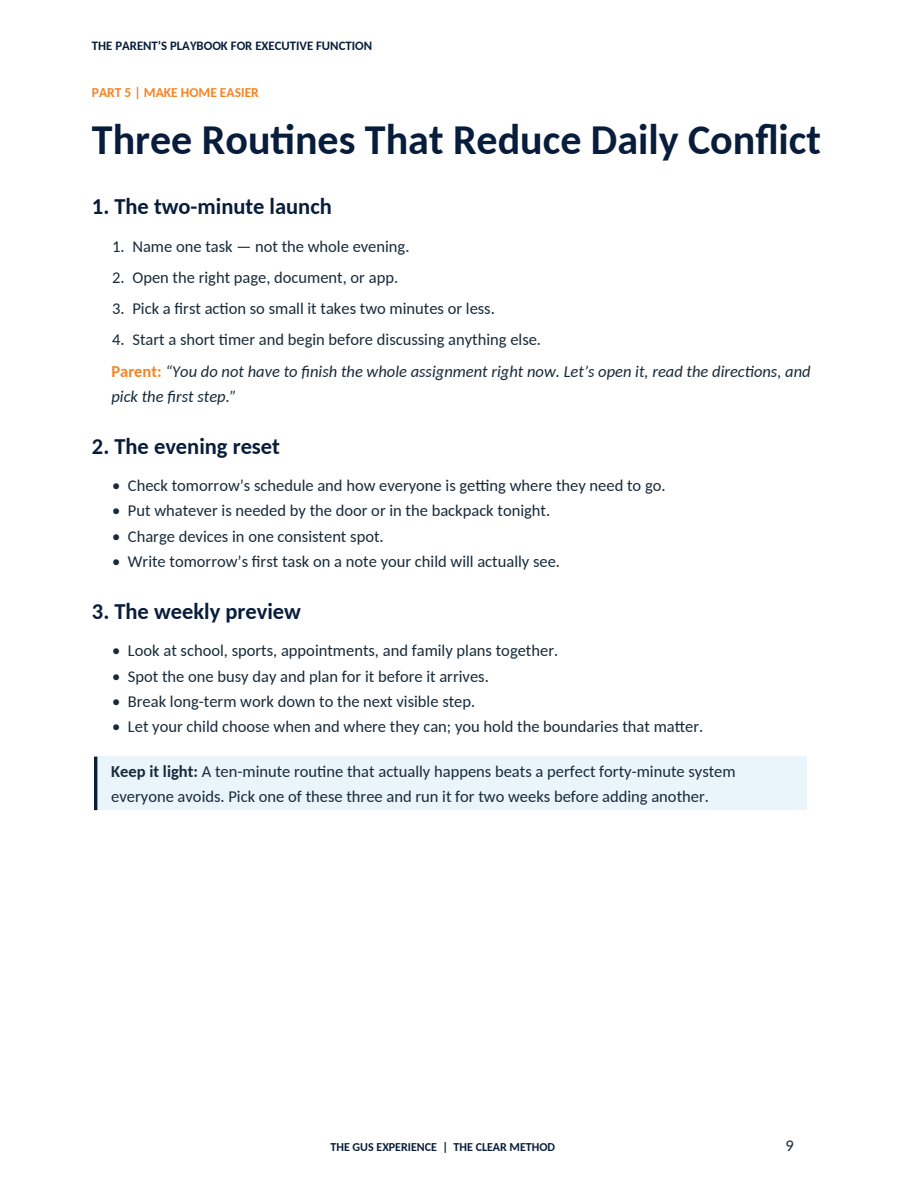
Try the two-minute launch, evening reset, and weekly preview. Each routine gives your family a concrete place to begin.

Practical guidance from Coach Gus for the moments when another reminder is not helping. Use conversation scripts, simple routines, and a shared plan to support the next step.
18 pages. August 2026 content. Updated GUS cover and colors. Emailed within one business day after purchase.

Try the two-minute launch, evening reset, and weekly preview. Each routine gives your family a concrete place to begin.
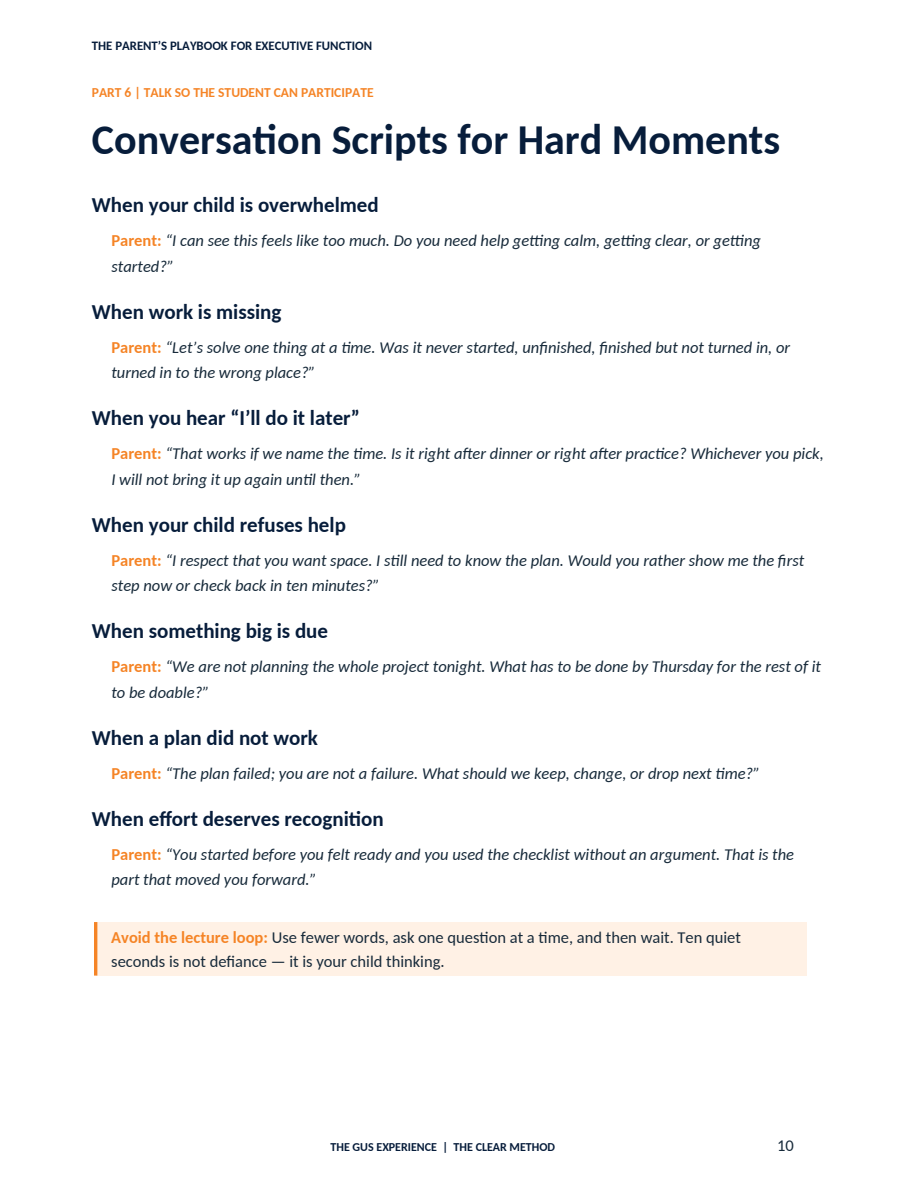
Use scripts for overwhelm, missing work, refused help, and plans that did not work. Practice the CLEAR Method together.
Start with a teacher email template, meeting questions, and a one-page student support plan. Review one skill over two weeks.
These are actual pages from the book. Select a page to open a larger image, or read the complete sample pages as text.
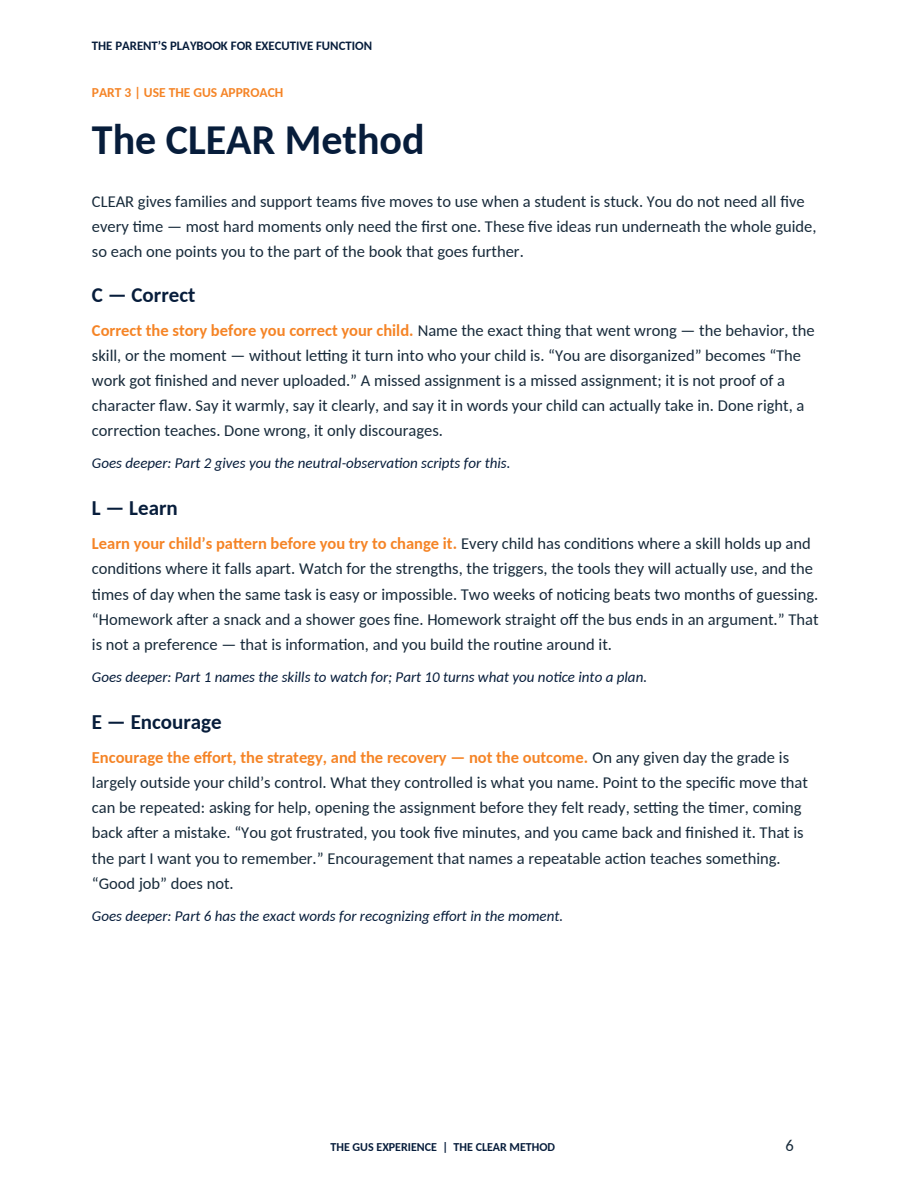
Part 3 | Use the GUS approach
CLEAR gives families and support teams five moves to use when a student is stuck. You do not need all five every time — most hard moments only need the first one. These five ideas run underneath the whole guide, so each one points you to the part of the book that goes further.
Correct the story before you correct your child. Name the exact thing that went wrong — the behavior, the skill, or the moment — without letting it turn into who your child is. “You are disorganized” becomes “The work got finished and never uploaded.” A missed assignment is a missed assignment; it is not proof of a character flaw. Say it warmly, say it clearly, and say it in words your child can actually take in. Done right, a correction teaches. Done wrong, it only discourages.
Goes deeper: Part 2 gives you the neutral-observation scripts for this.
Learn your child’s pattern before you try to change it. Every child has conditions where a skill holds up and conditions where it falls apart. Watch for the strengths, the triggers, the tools they will actually use, and the times of day when the same task is easy or impossible. Two weeks of noticing beats two months of guessing. “Homework after a snack and a shower goes fine. Homework straight off the bus ends in an argument.” That is not a preference — that is information, and you build the routine around it.
Goes deeper: Part 1 names the skills to watch for; Part 10 turns what you notice into a plan.
Encourage the effort, the strategy, and the recovery — not the outcome. On any given day the grade is largely outside your child’s control. What they controlled is what you name. Point to the specific move that can be repeated: asking for help, opening the assignment before they felt ready, setting the timer, coming back after a mistake. “You got frustrated, you took five minutes, and you came back and finished it. That is the part I want you to remember.” Encouragement that names a repeatable action teaches something. “Good job” does not.
Goes deeper: Part 6 has the exact words for recognizing effort in the moment.
Part 5 | Make home easier
Parent: “You do not have to finish the whole assignment right now. Let’s open it, read the directions, and pick the first step.”
Keep it light: A ten-minute routine that actually happens beats a perfect forty-minute system everyone avoids. Pick one of these three and run it for two weeks before adding another.
Part 6 | Talk so the student can participate
Parent: “I can see this feels like too much. Do you need help getting calm, getting clear, or getting started?”
Parent: “Let’s solve one thing at a time. Was it never started, unfinished, finished but not turned in, or turned in to the wrong place?”
Parent: “That works if we name the time. Is it right after dinner or right after practice? Whichever you pick, I will not bring it up again until then.”
Parent: “I respect that you want space. I still need to know the plan. Would you rather show me the first step now or check back in ten minutes?”
Parent: “We are not planning the whole project tonight. What has to be done by Thursday for the rest of it to be doable?”
Parent: “The plan failed; you are not a failure. What should we keep, change, or drop next time?”
Parent: “You started before you felt ready and you used the checklist without an argument. That is the part that moved you forward.”
Avoid the lecture loop: Use fewer words, ask one question at a time, and then wait. Ten quiet seconds is not defiance — it is your child thinking.
Includes a contents page and a completed student support plan. This is a concise digital guide, not a printed book or coaching package.
Four pages for a first step.
A fuller guide for continued practice.
For parents and caregivers helping a student with planning, starting, organization, remembering, or follow-through. You can use the guide at your own pace and print pages for your household.

Gus Kennedy is an educator and coach who works with students on practical executive-function skills.
Learn more about GusEducational information and skill-building. This book is not therapy, diagnosis, medical care, or subject tutoring. Results are not guaranteed.
One-time purchase · 18-page PDF
Personal household license
Your PDF will be emailed to the address used at checkout within one business day.
Secure payment through Stripe. You may cancel before delivery. After delivery, refunds are limited to the cases described in the refund policy.
You may use and print the PDF within your household. Redistribution, resale, public posting, and organizational copying are not permitted. For organizational permission or purchase help, email gus@thegusexperience.org.
Get this 18-page Parent’s Playbook and the 36-page Student Planner for $27. Save $4 compared with buying separately.
See the Parent + Student Bundle · $27Weekly ideas to help you stay connected with your teen and take an active role in their learning. Read The Sunday Huddle on Substack.
Read the Sunday Huddle